Want to know how you’re doing with your flexibility, muscle mass, body fat, condition and overall fitness? No need to rush off to the gym or a clinic. You can do most of these tests perfectly fine at home – in your pajamas, or during a quick break while watching your favorite movie.
Try it out. You might find out you’re not doing as badly as you think. Or… that it’s finally time to do something about it.
The Balance, Strength, and Flexibility Test All in One: Sitting Rising Test (SRT)
Sounds simple, right? But scientists agree this test can very accurately show how your musculoskeletal system is holding up. And here’s the kicker – it’s also a strong indicator of how long you might stick around on this planet.
Studies show that this test is a reliable predictor of mortality risk for people over 50 years old. So yeah, maybe it’s time to give it a shot.
It’s a super easy way to find out where you stand with balance, flexibility, and muscle strength. And guess what? These are exactly the things that older adults lose the fastest. Which is exactly why you should start working on them now, not later.
✅ How to Do It:
- Put on something comfortable.
- Take off your shoes (and socks too if you don’t want to slip).
- Stand up straight, take a deep breath, and relax.
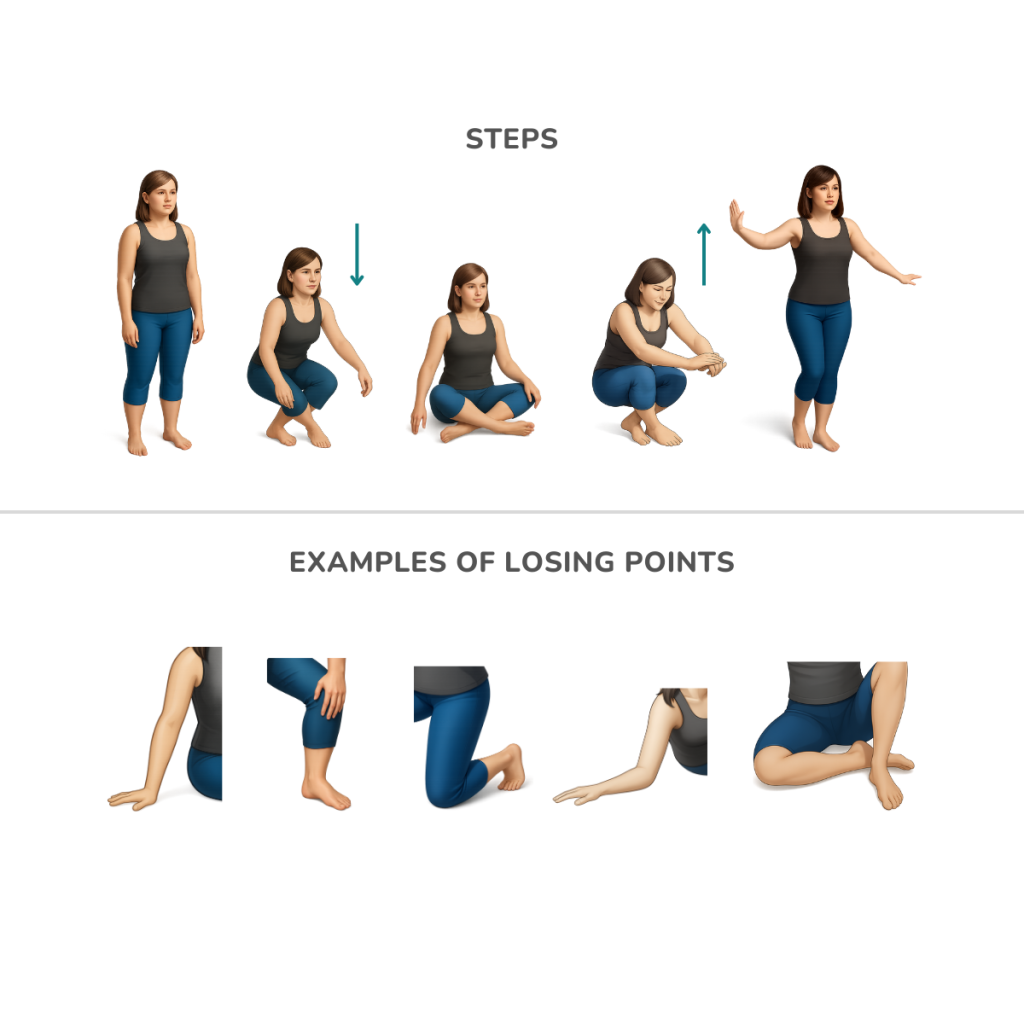
- Without leaning on anything, sit down on the floor with your legs crossed.
- Now for the harder part… Stand up without using your hands, knees, elbows, or pushing off anything.
Was that way too easy? Awesome. You’ve got this. If not… keep reading.
🏅 How Is It Scored?
- You start with 10 points.
- Every time you “cheat” by using a hand, knee, elbow, or any support?
Minus 1 point. - Lose your balance?
Minus 0.5 point. - And that’s it. The higher your score, the better.
Didn’t hit the full 10 points?
No panic—it’s all about knowing where you stand and what to do next.
➡️ Tip: Don’t treat it like a school grade. Treat it as your starting point. And yep, even here it applies:
If you’re at four points today, you could be at six a month from now.
📊 How to Read the Results?
10 to 8 points:
Congrats! Your flexibility, balance, and muscle strength are in solid shape! And hey, you’re even in the group of people who, according to research, tend to live the longest. Keep it up—but don’t forget, even great fitness can disappear faster than you can finish that afternoon cookie.
7.5 to 3.5 points:
Alright, that’s a flashing orange warning light.
Flexibility? Room for improvement.
Balance? You’ve got space to grow.
Muscles? They definitely deserve more attention.
And yes, science is pretty brutal here – people in this score range have up to a three-times higher risk of premature death.
What to do about it? Don’t feel sorry for yourself. Just start. Even with something small.
3 points or less:
We’re not talking about a warning light anymore – this is a full-on lighthouse flashing through a storm.
This is a serious signal that your body is crying for help. It doesn’t matter if you’re 30 or 60 – at this level, the risk of early death is more than six times higher.
You don’t have to start doing backflips. But at least start by taking the stairs instead of the elevator. Every small step counts.
BMI – That Old Familiar Number That Says Something… But Not Everything
BMI (Body Mass Index) has been around since the mid-19th century. It’s used to quickly assess body weight in relation to height, mainly for adults and teenagers.
➡️ This calculation doesn’t apply to kids!
They have their own growth charts (and if you’re curious, you’ll find more in the article: Childhood Obesity and Malnutrition).
📚 So, What’s BMI Even Good For?
Think of it as a quick health screening tool. It’s often used to assess health risks across large populations. Fast, simple, and accessible.
But… yeah, it definitely has its flaws.
📏 How Do You Calculate BMI?
👉 BMI = (weight in kg) / (height in m)²
But let’s be honest – who really wants to mess with math when you can just use our simple BMI calculator? Plus, it’ll tell you what your result actually means.
🤔 Does BMI Have Its Flaws? Oh, Absolutely…
- “Normal weight” according to BMI?
You might have it, but still be carrying a surprising amount of fat. Or you could be what’s called “skinny fat” – you look slim, but that fat is sitting exactly where it shouldn’t. And that’s definitely not a health win. - “Overweight or obese” according to BMI?
In 99% of cases, it’s accurate. Yep, there’s just that much fat present.
The exception? If you’re in that rare 1% of athletes who’ve packed on more muscle than your average action movie star.
➡️ Bottom Line?
BMI isn’t totally useless – but when it comes to your health, the amount of body fat you carry matters way more than just a number on a chart.
Want to dive deeper into this? Check out the article: 👉 BMI isn’t a rulebook. But do you know when you can actually trust it?
Body Fat Percentage – A Number That Tells You More Than the Scale Ever Will
As we already mentioned, your body fat percentage is a key indicator of your health. You can hit the “ideal” weight according to the charts, but if your body is carrying more fat than muscle, we can’t really call that healthy, can we?
📊 How to Make Sense of the Numbers? Here Are Some General Guidelines:
| Category | Women | Men |
|---|---|---|
| Essential Fat* | 8 – 14% | 4 – 7% |
| Lean | 15 – 20% | 8 – 13% |
| Normal Range | 21 – 24% | 14 – 21% |
| Mild to Moderate Overweight | 25 – 32% | 22 – 25% |
| Obesity | 33% and above | 26% and above |
* Essential fat is what your body needs to survive. If you go below these numbers, we’re no longer talking about health—we’re talking about a problem that’s only a matter of time before it shows up.
Visual Body Fat Estimate – Yep, a Mirror (and a Bit of Honesty) Still Works
You don’t always need fancy gadgets worth thousands of dollars. Sometimes, all it takes is a clear-eyed look in the mirror and a little healthy self-awareness.
Try comparing yourself to reference images that show different body types and estimated body fat percentages.


➡️ The important thing isn’t just how much fat you have, but where it’s stored.
If your waist measurement is larger than your hips, it’s time to pay attention. With fat stored this way, your risk of heart disease and type 2 diabetes goes way up.
📏 Specific Numbers?
- Women: Waist circumference of 89 cm (35 inches) or more = higher risk.
- Men: Waist circumference of 102 cm (40 inches) or more = higher risk.
Online Body Fat Calculators – Can You Trust Them?
You’ll find dozens of them online, but let’s be real – most of them should probably be deleted rather than trusted.
One of the more accurate ones is the Body Fat Calculator – feel free to try it out, but take the results with a grain of salt.
And the good news? We’re working on our own calculator directly on Nutrelino.
It’ll be simple, practical, and—most importantly—more reliable.
Other Ways to Measure Body Fat (But Don’t Take Them as Absolute Truth)
- Caliper Measurements (Skinfold Test):
A handy tool, but you really have to know where and how to measure properly. Otherwise, it’s just playing with numbers. - Bioelectrical Impedance Scales (BIA):
Fast and easy, but results can fluctuate depending on how hydrated you are or what you just ate.
They’re better for tracking long-term trends, not one-off results. - Professional Equipment (DEXA, InBody, etc.):
If you’re looking for the most accurate measurement and don’t mind paying for it, this is the way to go.
But just a heads-up—it’s not exactly a cheap option.
How’s Your Fitness? You’ll Find Out Faster Than You Think.
You probably already have a rough idea of where you stand. But if you’d rather stop guessing and deal with hard facts, try these simple tests.
You can assess your body in four key areas:
- Resting and aerobic heart rate ❤️
- Muscle mass and endurance 🏃♀️💪
- Flexibility 🤸
- BMI (yep, we already talked about that one above)
❤️ Resting Heart Rate (RHR) – What’s Your Heart Trying to Tell You?
Your heart can actually reveal a lot about your fitness. The better shape it’s in, the slower and more efficiently it beats.
📏 How to Measure It:
- Measure your heart rate right after waking up, still lying down. Don’t even stand up before you measure.
- Find your pulse on your neck or wrist.
- Count the beats for 10 seconds and multiply by 6.
📊 What the Numbers Mean:
- 50 – 70 beats per minute: Your engine is running smooth.
- Up to 100 beats per minute: Still within normal, but there’s room for improvement.
- 40 beats per minute or less? You’re either a supercompensated athlete… or let’s be honest, probably just an athlete.
📣 Heads up if your resting heart rate suddenly spikes higher:
It could be a sign of overtraining, an oncoming illness, or simply that you forgot to give yourself enough rest.
Want to know what heart rate zones are healthy for you based on your age?
Check out our Heart Rate Zone Calculator!
🏃♀️ Running Test – A Quick Way to Find Out if Climbing Stairs Really Wipes You Out
Run 1.5 miles (2.4 km) and check the table to see where you stand:
| AGE | WOMEN (min.) | MEN (min.) |
|---|---|---|
| 25 | 13 | 11 |
| 35 | 13,5 | 11,5 |
| 45 | 14 | 12 |
| 55 | 16 | 13 |
| 65 | 17,5 | 14 |
The fewer minutes, the better.
And if it doesn’t feel realistic just yet? No worries. Every step counts.
💪 Muscle Strength and Endurance Test – Push-Ups and Sit-Ups, Old-School but Still Effective
Why do we care so much about this?
Because muscle mass and strength – are incredibly important for your health. Studies have shown that low levels of muscle mass and strength are directly linked to higher mortality from all causes.
Push-Up Test:
- Get into a proper push-up position (no knees on the floor!).
- Do technically correct, full push-ups until you just can’t anymore.
| AGE | WOMEN (reps) | MEN (reps) |
|---|---|---|
| 25 | 20 | 28 |
| 35 | 19 | 21 |
| 45 | 14 | 16 |
| 55 | 10 | 12 |
| 65 | 10 | 10 |
Sit-Up Test:
- Sit down so that your knees and hips form a 90° angle.
- For one minute, count how many times you can raise your head and shoulders off the floor.
- And no cheating – don’t jerk your body or lift your butt off the floor. Exhale fully on the way up, return to the starting position, inhale, and repeat.
| AGE | WOMEN (1 min.) | MEN (1 min.) |
| 25 | 39 | 44 |
| 35 | 30 | 40 |
| 45 | 25 | 35 |
| 55 | 21 | 30 |
| 65 | 12 | 24 |
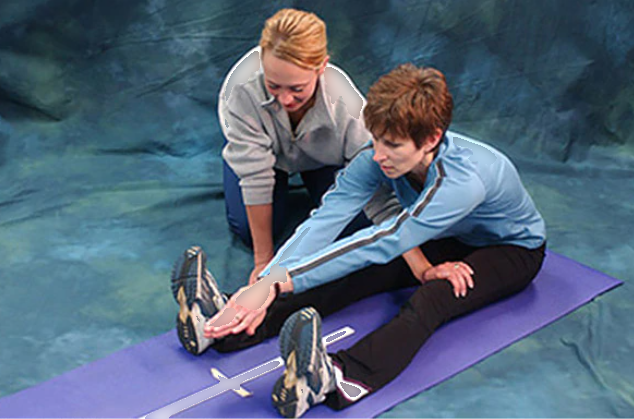
🤸 Flexibility Test – So, Can You Still Touch Your Toes?
- Place a measuring tape on the floor and fix it so that 0 starts where you’re sitting, and your feet are at the 38 cm (15 inches) mark.
- Sit down with your legs fully extended, heels placed at the 38 cm mark.
- Slowly lean forward, exhale, and hold that stretch for a second.
- Record how far you can reach with your fingertips.
- Feel free to repeat the test at least three times and write down your best result.
*https://www.mayoclinic.org/healthy-lifestyle/fitness/in-depth/fitness/art-20046433
| AGE | WOMEN (cm) | MEN (cm) |
| 25 | 55 | 60 |
| 35 | 52.5 | 47.5 |
| 45 | 51 | 44.5 |
| 55 | 48 | 42 |
| 65 | 44.5 | 39.5 |
How to Get Better Results?
Just walking around the block doesn’t quite count as a serious workout (although hey, it’s better than nothing). If you’re serious about improving your fitness, strength, and flexibility, it’s time to add some activities that will really help you make progress.
➡️ Basic Rule? Stay active most days of the week. Your body will thank you for it.
✅ Recommendations for a Healthier, Stronger YOU:
- 150 minutes of moderate aerobic activity per week
(or at least 75 minutes of intense activity—if you’re feeling up for it)
Moderate Aerobic Activity:
Brisk walking
Easy-paced swimming
Flat-terrain cycling
Gardening (yep, even yard work counts!)
Intense Aerobic Activity:
Running
Fast and longer swimming sessions
Cycling in tough terrain
Tennis, basketball, soccer, volleyball, and other “more action-packed” sports
- Don’t Forget About Your Muscles! Do strength training at least 2–3 times a week.
Use dumbbells, resistance bands, or just your own bodyweight (push-ups, squats, planks).
➡️ Tip: Don’t try to do everything at once. Gradually increase the intensity – ideally in a way that keeps you enjoying it without completely burning out.
And When Should You Check Your Progress?
Feel free to repeat your measurements every 6 weeks. You’ll see how you’re changing—and honestly, that’s the best proof that what you’re doing actually works.
It doesn’t matter where you are right now—what matters is where you’re headed.
Even small changes make a big difference if you give them time and stick with it.
➡️ So, what do you say? Are you going to try it today and check back in 6 weeks?
Not for the numbers. But for that amazing feeling when you realize this whole thing actually makes sense. Let’s do this!
Research-based sources
https://journals.sagepub.com/doi/10.1177/2047487312471759
https://www.mayoclinic.org/healthy-lifestyle/fitness/in-depth/fitness/art-20046433
https://pubmed.ncbi.nlm.nih.gov/28991040/
https://www.ncbi.nlm.nih.gov/pmc/articles/PMC4890841/
https://examine.com/nutrition/how-valid-is-bmi-as-a-measure-of-health-and-obesity/
https://www.ncbi.nlm.nih.gov/pmc/articles/PMC6469873/
https://pubmed.ncbi.nlm.nih.gov/11965822/
https://www.ncbi.nlm.nih.gov/books/NBK535456/
https://journals.sagepub.com/doi/10.1177/2047487312471759
How to Overcome What We Tell Ourselves about Diets, Weight, and Metabolism, Dr. Nadja Hermann, 2019