
Nutrition and fitness today are full of terms, abbreviations, and “guaranteed truths” that are often taken out of context, oversimplified, or completely distorted. The result? Confusion, frustration, and the feeling that if something isn’t working, the problem must be your body.
This article was created to bring things back to reality: biological, measurable, and understandable. No extremes. No trends. No unrealistic promises.
In this article, we’ll gradually explain:
- what calories and energy really are and why they can’t be bypassed,
- the difference between macronutrients and micronutrients and their basic classification,
- how energy balance works (deficit, surplus, maintenance),
- why body composition matters more than the number on the scale,
- what BMR and RMR mean as your metabolic baseline,
- what makes up TDEE: your total daily energy expenditure,
- BMI – Body Mass Index,
- how hormones, refeed, and insulin actually work in real life,
- what insulin resistance is and how body fat is involved,
- glycemic index and glycemic load,
- what adaptive thermogenesis and “starvation mode” really mean,
- why NEAT is the biggest source of differences between people,
- how much energy it costs to process food (TEF),
- and when body recomposition is realistic and when it isn’t.
The goal isn’t to convince you of one “correct” approach. The goal is to understand how the body works, so you can make decisions based on facts, not fear or trends.
Calories: the foundation you can’t bypass
A calorie is not a diet. A calorie is not the enemy. And it’s definitely not a modern invention. A calorie is simply a unit of energ, specifically, the amount of energy required to raise the temperature of one kilogram of water by one degree Celsius. In nutrition, it’s used to express the energy content of foods and beverages.
In practice, you’ll encounter two units: kcal and kJ. They represent the same energy, just written differently. The conversion is simple: 1 kcal = 4.18 kJ. From the perspective of weight loss, weight gain, or health, there is no difference between them.
You can’t trick energy, and you can’t avoid it. You can eat “clean,” you can eat low carb, keto, or intuitively. The body still runs on energy. That’s not a trend. That’s physics.
And that’s exactly why we need to move beyond calories themselves… to where that energy actually comes from.
Macronutrients and micronutrients: where energy comes from
Macronutrients are the core components of our diet that provide the body with energy. These include proteins, fats, and carbohydrates (along with fiber, which plays a specific role in digestion and satiety). Each of them has a different function and a distinct biological role.
Carbohydrates = the primary source of energy
Carbohydrates are classified based on their structure and the speed at which they’re absorbed:
- Monosaccharides: simple sugars (glucose, fructose). Rapidly absorbed and a quick source of energy.
- Oligosaccharides: a slower source of energy:
- disaccharides (sucrose, lactose, maltose),
- trisaccharides (e.g., raffinose),
- oligosaccharides such as inulin.
- Polysaccharides: complex carbohydrates (starch, glycogen, pectins, fiber). They’re absorbed slowly, keep you fuller for longer, and form the foundation of long-term energy supply.
Fats = energy storage and hormonal regulation
Fats in the diet are not “just extra calories.” They’re essential for hormone production, the nervous system, and the absorption of vitamins A, D, E, and K.
Basic classification:
- saturated fats (commonly found in animal products and some oils),
- unsaturated fats (mono- and polyunsaturated = typically found in fish, nuts, and olive oil),
- trans fats (this is the category you really don’t want to consume often).
Proteins = building material
Proteins primarily serve to:
- build and repair muscle tissue,
- form enzymes and hormones,
- support immune function.
They’re not a primary energy source, but they do have a high thermic effect (see below).
In practice, proteins are most often categorized by their source and “completeness”:
- animal proteins (meat, fish, eggs, dairy): usually considered amino-acid complete,
- plant proteins (legumes, grains, nuts, seeds): can be perfectly adequate, but often require combining different sources.
Micronutrients
Vitamins, minerals, and trace elements provide little to no energy, but without them the body simply can’t function properly. They affect the nervous system, immunity, recovery, hormones, and metabolic processes.
Vitamins are classified by their solubility:
- water-soluble vitamins (B-complex vitamins, vitamin C), which the body generally doesn’t store and therefore need to be consumed regularly,
- fat-soluble vitamins (A, D, E, K), which are stored in fat tissue and whose absorption depends on the presence of dietary fat.
Minerals and trace elements (such as calcium, magnesium, iron, zinc, iodine, selenium) are essential for proper enzyme activity, hormone function, nervous system signaling, and muscle contraction.
One doesn’t work without the other. You can have a perfectly calculated calorie intake and an “ideal” meal plan, but without adequate micronutrients, the body won’t run efficiently. And on the flip side, even so-called “superfoods” won’t fix a long-term broken energy balance.
Energy value of macronutrients
Each macronutrient provides a different amount of energy:
- Carbohydrates: 4 kcal per gram
- Protein: 4 kcal per gram
- Fat: 9 kcal per gram
- Alcohol: 7 kcal per gram (not a macronutrient, but worth mentioning)
- Fiber: approximately 2 kcal per gram (depending on type and gut fermentation)
This difference in energy density is why the same volume of food can have very different calorie content.
Energy balance: deficit, surplus, and maintenance
Changes in body weight and body composition are always the result of energy balance.
An energy deficit occurs when you expend more energy than you consume. The result is weight loss, primarily a loss of body fat.
An energy surplus means you consume more energy than your body uses. It’s necessary for building muscle mass (assuming proper strength training).
A balanced energy intake means maintaining your current state.
Yes, it’s possible to build muscle in a deficit, but mostly in beginners and in people with a higher body fat percentage. In very lean and advanced individuals, this process is significantly limited.
👉 If you want to know how many calories to eat for your goal (weight loss / weight gain / maintenance), check the Target calculator.
And this is where we get to a concept that’s far more important than the number on the scale.
Body composition: more than just a number on the scale
Body composition reflects the ratio of fat mass to muscle mass. Two people can weigh the same and have completely different health profiles.
What matters isn’t only how much fat you have, but also where it’s stored.
Fat stored around the abdomen (visceral fat) is metabolically active and is associated with a higher risk of:
- insulin resistance,
- type 2 diabetes,
- cardiovascular disease.
Risk waist circumference values:
- women: over 35 inches (≈ 89 cm)
- men: over 40 inches (≈ 102 cm)
A “normal” weight does not automatically mean good health.
BMR and RMR: the metabolic minimum for life
BMR (Basal Metabolic Rate) represents the amount of energy your body needs to maintain basic жизнен… life-sustaining functions: breathing, heart activity, brain function, liver and kidney function, and thermoregulation. It accounts for roughly 60–70% of total daily energy expenditure.
RMR (Resting Metabolic Rate) is a more practical metric for everyday life. In addition to the basic functions covered by BMR, it also includes minor activities at rest and what realistically happens throughout the day.
BMR/RMR calculations are only estimates, because they don’t account for the exact ratio of muscle mass to fat mass. That’s why they can underestimate energy expenditure in muscular individuals and overestimate it in people with a higher amount of body fat. This is also why two people with the same body weight can have completely different BMR values.
👉 Calculate your BMR using our calculator and treat it as a “metabolic minimum,” not a personal insult.
You can read more about BMR in this article: Why a “slow metabolism” or “starvation mode” is not the problem in weight loss. Metabolism, NEAT, and real differences between people
TDEE: total daily energy expenditure
TDEE (Total Daily Energy Expenditure) represents the total amount of energy you burn in a day. It’s not a single number, but the sum of several processes:
- BMR/RMR (your metabolic minimum) plus work-related stress,
- physical activity (intentional movement, e.g. training),
- NEAT (non-exercise, unintentional movement),
- TEF (the energy required to process food).
TDEE is a dynamic value. It changes with body weight, behavior, stress levels, sleep, and diet. That’s why it’s an illusion to think that a number calculated once “applies forever.” These values need to be updated regularly.
If you want clarity on where you stand, start by calculating your TDEE. You can use our TDEE calculator for that.
BMI: a simple tool with major limitations
BMI (Body Mass Index) is one of the most commonly used metrics because it’s quick and simple. Advantage: speed. Weakness: reality. It’s used for a quick assessment of body weight relative to height, at least in adults. For children, different reference charts apply.
BMI does not distinguish muscle from fat, nor does it account for age or fat distribution. Research shows that a large proportion of people classified by BMI as having “normal weight” may actually have a high body fat percentage. On the other hand, in athletes BMI can look “worse” than it really is and than what their health status reflects.
That’s why BMI is suitable as an orientation or screening tool, not as a precise diagnostic measure.
BMI calculations often fail especially in older adults. Why? One of the main reasons is sarcopenia.
Sarcopenia is the gradual loss of muscle mass, strength, and function that typically accompanies aging, but it can also occur with a sedentary lifestyle and chronic diseases. Key factors in its development include low physical activity and long-term insufficient intake of protein, as well as vitamins and minerals.
That’s why a person can have a “normal BMI” while still having low muscle mass and a higher health risk, something BMI simply cannot distinguish.
👉 Calculate your BMI using a calculator, but treat it as a first estimate, not a verdict.
If you’re interested in more information about BMI, you can find it on our blog in this article: BMI isn’t a rulebook. But do you know when you can actually trust it?
Hormones: regulators of behavior, not saboteurs
Leptin, ghrelin, cortisol, insulin
They have a major influence on how you feel, what you want to eat, how full you feel, and how much energy you have. But the core rule still applies: they don’t create fat out of thin air.
Leptin is the satiety signal. When its levels drop (for example during a strict diet or extreme training), the brain gets the message “energy is low.” The result? More hunger, less satiety, and poorer adherence to the plan.
Ghrelin is the hunger hormone. It rises with lack of sleep and prolonged calorie deficits. That’s not sabotage, that’s the body trying to secure energy.
Cortisol increases with stress, excessive training volume, lack of sleep, and long-term calorie restriction. Elevated cortisol worsens recovery, promotes water retention, and often increases hunger and fatigue. That’s why people after drastic diets often don’t look “leaner,” but rather exhausted and water-retained.
Insulin: a hormone of life, not an enemy
Insulin is a hormone produced by the pancreas and is essential for life. Its roles are very practical:
- it helps transport nutrients into cells,
- allows the body to use glucose as energy,
- regulates carbohydrate, fat, and protein metabolism,
- enables energy storage – but the key word is excess.
Glucose can be used immediately as fuel, or stored as glycogen in the liver and muscles. Muscle glycogen is used mainly during training, while liver glycogen helps maintain stable blood glucose levels.
Important: insulin doesn’t rise only after carbohydrates. Protein and fat can increase insulin as well (to different degrees and depending on context). That’s why it’s an oversimplification to claim that “only carbs are bad.”
And even more important: the amount of insulin does not determine how much fat you store. The biggest driver of fat gain is still excess energy intake.
The takeaway: hormones usually do this, they increase appetite, reduce spontaneous movement, and make adherence harder. They are amplifiers of behavior, not biological saboteurs.
Refeed: why a short-term calorie increase is not failure
There’s one often misunderstood fact that goes against the fitness logic of “the less, the better.” A short-term increase in calorie intake, especially from complex carbohydrates, known as a refeed, can have a positive biological effect.
A refeed can lower cortisol, temporarily increase leptin signaling, improve energy and performance, and reduce water retention. Importantly, short-term changes in leptin are not directly tied to body fat levels, but rather to how the body perceives energy availability and how glucose is processed in fat cells.
The problem with extremely long diets without breaks isn’t a “ruined metabolism,” but rising stress, poorer recovery, and declining sustainability. Well-designed maintenance phases or refeeds are therefore not a weakness. They are strategic tools. Not a hack, just biology in practice.
Insulin resistance (IR): when the body needs more insulin
Insulin sensitivity describes the relationship between how much insulin the body needs to move glucose into cells. The higher the sensitivity, the less insulin is required.
With insulin resistance, the pancreas must produce more insulin to achieve the same effect. It’s often associated with:
- a higher percentage of body fat,
- low NEAT,
- long-term unhealthy lifestyle habits.
In type 2 diabetes, a very common and logical solution is fat loss and lifestyle change, often without the need for extreme low-carb approaches.
Glycemic Index (GI) and Glycemic Load (GL): useful for some, but not sacred rules
The glycemic index (GI) describes how quickly and how strongly a food raises blood glucose levels.
It is usually categorized as:
- low: 0 – 55
- medium: 55–69
- high: 70+
Glycemic load (GL) also takes into account the amount of carbohydrates in a serving, making it more practical, because in real life, portion size matters.
GI/GL can be useful for people with diabetes or insulin resistance, but for a healthy person, they are not a magical “healthy vs. unhealthy” rule. From a weight-loss perspective, energy balance and overall diet quality still matter most, not a GI table.
Adaptive thermogenesis and “starvation mode”
Adaptive thermogenesis is real, but often greatly exaggerated. It means that energy expenditure decreases slightly more than would be expected from weight loss alone.
Research shows this effect is small, mild, and temporary, and it significantly weakens or disappears entirely once body weight stabilizes. In practice, we’re talking about tens of calories per day, not hundreds.
The body isn’t trying to sabotage weight loss. It’s simply becoming more energy-efficient. That’s not a malfunction. It’s a logical adaptation:
- a smaller body needs less energy,
- you unconsciously reduce NEAT—less fidgeting, less foot tapping, fewer spontaneous movements,
- there is a loss of metabolically active tissue—muscle, which also lowers calorie needs.
Everything here follows a clear logic, and there’s no need to panic about it.
You can read more about this topic here: Why a “slow metabolism” or “starvation mode” is not the problem in weight loss. Metabolism, NEAT, and real differences between people
NEAT: where the real differences between people come from
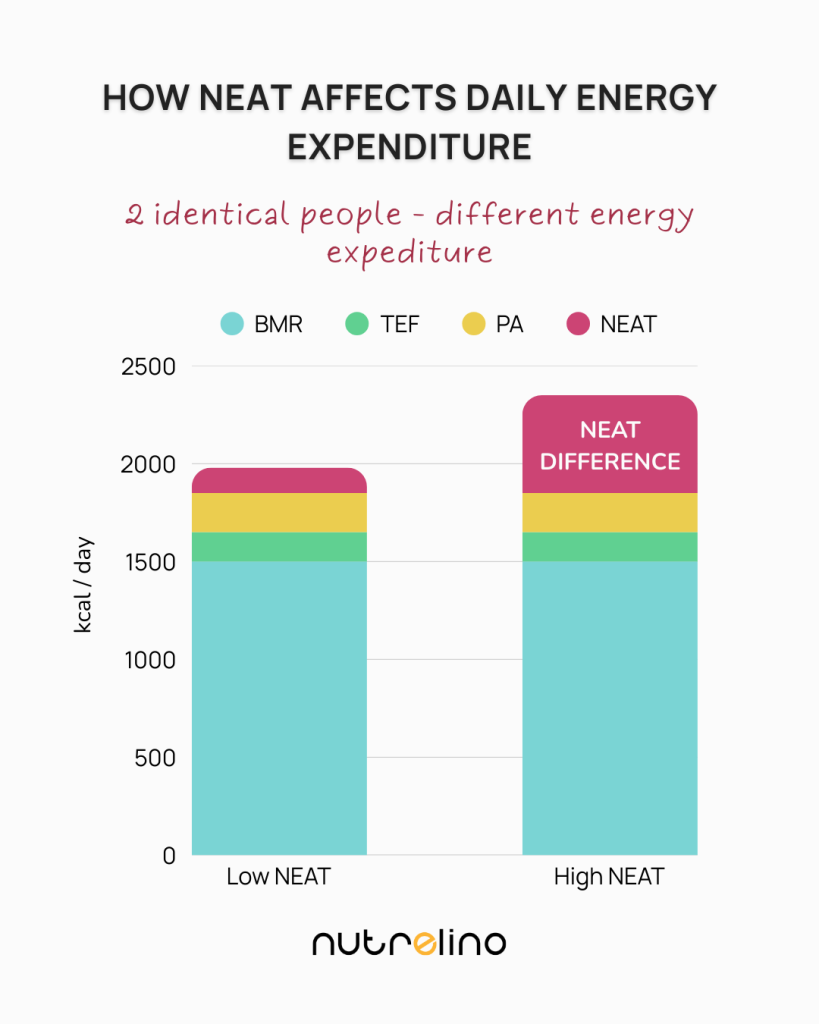
NEAT (Non-Exercise Activity Thermogenesis) includes all movement outside of formal exercise, mostly unconscious movement: walking, standing, changing positions, gesturing, fidgeting, tapping fingers, and similar small activities.
In sedentary individuals, NEAT may account for around 15% of total energy expenditure. In very active people, it can make up more than 50%. This means that differences between people who look “similar” on paper can easily reach 200 – 600 kcal per day.
This is exactly why it often seems like some people have a “faster metabolism.” In reality, the difference lies in day-to-day behavior, not in some magical metabolic advantage.
We go much deeper into NEAT in this article: Why a “slow metabolism” or “starvation mode” is not the problem in weight loss. Metabolism, NEAT, and real differences between people
The following chart shows why two people with the same BMR and training routine can have completely different total daily energy expenditure — the difference isn’t the workout, it’s NEAT.
TEF and protein
TEF (Thermic Effect of Food) is the energy your body uses to digest, absorb, and process food:
- fats: 1 – 3%
- carbohydrates: 5 – 10%
- protein: 15 – 30%
A higher protein intake can slightly increase energy expenditure. This is a biological fact, not a miracle.
Body recomposition: when it works and when it doesn’t
Body recomposition means gaining muscle while losing fat at the same time. It is physiologically possible, but not equally achievable for everyone.
It most commonly works in:
- beginners,
- people with a higher body fat percentage,
- people who haven’t trained with weights before and start sensibly, or who trained very minimally in the past.
In very lean, advanced athletes, this process is significantly limited. The body doesn’t have a large energy “buffer,” and building muscle in a calorie deficit becomes difficult.
If you want to turn these concepts into real-life results, you don’t need another “hack.” You need numbers that actually make sense:
- BMI calculator (for orientation)
- BMR calculator (your metabolic minimum)
- TDEE calculator (your real daily energy expenditure)
- Target calculator (how many calories and macros to eat based on your goal)
Nutrition and movement aren’t about perfection or extremes. They’re about understanding the basics.
If you don’t understand what energy is, what your energy expenditure consists of, and how your body responds to a long-term routine, you’re not in control of the process — you’re just hoping it will “somehow work out.”
Calories, macros, hormones, NEAT, or metabolism aren’t enemies. They’re tools. When you understand them, you can set a goal, adjust it over time, and respond to reality — not myths.
If you want results that are truly sustainable long term, you need data, not promises. That’s exactly what calculators, tracking, and analysis are for — so you don’t have to rely on guesses, but on facts.
Because if you don’t measure it, you don’t control it.
Sources:
- https://rnd.edpsciences.org/articles/rnd/abs/1996/04/RND_0926-5287_1996_36_4_ART0005/RND_0926-5287_1996_36_4_ART0005.html
- https://www.ncbi.nlm.nih.gov/pubmed/22485140
- https://clinicalnutritionespen.com/article/S1751-4991(11)00006-0/pdf
- https://www.ncbi.nlm.nih.gov/pmc/articles/PMC2278845/
- https://examine.com/topics/metabolic-rate/
- https://www.webmd.com/fitness-exercise/difference-between-bmr-and-rmr#2
- Conquering Fat Logic: how to overcome what we tell ourselves about diets, weight, and metabolism, Nadja Hermann
- https://pubmed.ncbi.nlm.nih.gov/20627487/
- https://pubmed.ncbi.nlm.nih.gov/23090575/