
Slow metabolism. Broken metabolism. Starvation mode…
Terms that show up suspiciously often in weight loss discussions and that sound as if your body is working against you.
In this article, we’ll walk step by step through what metabolism actually is, what makes up your daily energy expenditure, and where real differences between individuals truly come from. We’ll look at basal metabolism, the thermic effect of food, movement, NEAT, metabolic adaptation, hormones, and sleep – without myths, without magic, and without dramatic shortcuts from the internet.
The goal is not to look for excuses or miracle solutions.
The goal is to understand how the body works, what you can influence and what you can’t—and why most problems blamed on a “slow metabolism” have nothing to do with a disorder, but everything to do with perfectly logical biology.
If you want to stop fighting your body and start working with it, you’re in the right place.
What Metabolism Is and How It Works
Metabolism refers to all the chemical processes that take place in a living organism and allow it to function, survive, and stay alive.
Simply put, metabolism converts food into energy that the body needs for movement, growth, tissue repair, regulation of body temperature, and the function of organs.
These metabolic processes are divided into two basic types:
- catabolic reactions – the breakdown of substances and the release of energy,
- anabolic reactions – the building and synthesis of compounds that, on the contrary, require energy.
Metabolism, how it functions, and even its perceived “speed” are largely shaped by evolution. The body operates according to precise biological principles that cannot be trained, “reset,” or magically reprogrammed to burn only fat or function in a completely different way than it is designed to.
Most of the energy used by metabolism is consumed by organs: the heart, brain, liver, kidneys, and lungs. These organs cannot simply slow down or speed up their activity, because doing so would be dangerous and life-threatening. Anyone who claims they can “switch off” or dramatically speed up metabolism at the level of organs is either misleading or denying the basic principles of biology.
At the same time, the body does not run on just one energy source. Carbohydrates, fats, and proteins are used roughly simultaneously. What changes is their proportion, depending on the situation, especially the intensity and duration of physical activity.
During longer, lower-intensity activity, the proportion of energy coming from fats gradually increases. As intensity rises, however, carbohydrate utilization increases and the contribution of fatty acids as an energy source decreases.
When intensity increases even further (approximately above 75% of maximum workload – Wmax), oxidation of muscle glycogen and blood glucose rises significantly, while fat burning drops sharply. During strength training and high-intensity exercise, muscles primarily rely on glycogen.
Once glycogen is depleted, muscle strength and performance decline. Under these conditions, fat is simply not a fast or efficient energy source for muscles.
Metabolic “Speed” = What People Actually Mean by It
When people say they have a “slow metabolism,” they usually do not mean metabolism in the biological sense of the word. What they are actually talking about is how many calories their body burns in a day.
In practice, this term is used under several different names. Most of the time, people mean the same thing:
- how much energy their body needs per day,
- how many calories they should consume daily,
- or what their total daily energy expenditure (TDEE) is.
In other words, it comes down to how much energy your body needs over a 24-hour period in order to function, from basic life-sustaining processes all the way to movement.
This is where confusion often arises.
Fatigue, stress, a long history of dieting, extremes in eating patterns, lack of sleep, comparing oneself to others, or misunderstanding unintentional movement (NEAT) can all lead to the feeling that “metabolism isn’t working.” In reality, however, this is simply the sum of multiple components of energy expenditure, not a broken system and not some kind of magical failure. It makes sense.
What Total Daily Energy Expenditure Is Made Of
Total daily energy needs are not a single number. They are the sum of multiple processes that run continuously in the body. Some of them can be influenced, others cannot. Together, they form what we refer to as TDEE = Total Daily Energy Expenditure.
It includes:
- BMR (Basal Metabolic Rate)
- RMR (Resting Metabolic Rate)
- TEF (Thermic Effect of Food)
- AEE (Activity Energy Expenditure), which is divided into:
- PA (Physical Activity – exercise)
- NEAT (Non-Exercise Activity Thermogenesis) – energy expended through unintentional activity outside of exercise
Each of these components carries a different weight in total energy expenditure, and it is their combination that determines how much energy your body needs each day.
If you want to know your total daily energy expenditure (TDEE), you can calculate it using our TDEE calculator.
BMR and RMR: Energy Required for Basic Body Functioning
BMR (Basal Metabolic Rate) and RMR (Resting Metabolic Rate) represent the amount of energy your body needs to stay alive and function properly. These terms are often confused, but they are not exactly the same.
BMR – Basal Metabolic Rate
BMR represents the number of calories the body uses for basic life-sustaining functions such as:
- blood circulation,
- breathing,
- maintaining body temperature,
- digestion,
- cell, skin, and hair renewal,
- simply the work of all internal organs, because they consume a lot of energy…
Basal metabolic rate accounts for approximately 60 – 70% of total daily energy needs.
It is estimated using various formulas and equations, but these values are only approximations. The most accurate measurement of BMR is done in laboratory conditions -early in the morning after waking up, following a full night of rest, and without any prior physical activity.
To better understand why BMR makes up such a large portion of daily energy expenditure, let’s look at how much energy individual tissues and organs consume.
Approximate daily energy expenditure of individual tissues and organs per 1 kg of body weight:
- brain = 240 kcal/kg
- heart = 440 kcal/kg
- kidneys = 440 kcal/kg
- liver = 200 kcal/kg
- skeletal muscle = 13 kcal/kg
- residual mass (skin, intestines, bones, lungs) = 12 kcal/kg
- adipose tissue (fat) = 4.5 kcal/kg
From these numbers, it is clear that the largest part of basal metabolism is not made up of muscle or fat, but of organs that work continuously… regardless of whether you exercise, sleep, or just sit.
RMR – Resting Metabolic Rate
RMR indicates the amount of energy the body uses at rest, while also including minor activities that do not require significant effort, such as:
- chewing and swallowing,
- short walks,
- basic hygiene activities,
- caffeine processing,
- sweating or thermoregulation.
RMR is calculated using the same formulas as BMR and can also be measured in a laboratory—without the need to sleep in the facility, just a period of physical rest is sufficient.
👉 For everyday life, RMR is a more practical metric, because it better reflects real-world daily body function than strictly measured basal metabolism.
Thermic Effect of Food (TEF): Energy Required to Process Food
Part of daily energy expenditure is also the Thermic Effect of Food (TEF). This represents the amount of energy the body must expend to digest, absorb, and process food after consumption.
In other words: eating itself also “costs” energy.
In standard calculations and calculators, TEF is usually estimated at approximately 10% of total daily energy expenditure. In reality, however, it depends primarily on diet composition, specifically the ratio of macronutrients.
TEF of individual macronutrients:
- fats: approximately 1 – 3%
- carbohydrates: approximately 5 – 10%
- proteins: approximately 15 – 30%
This means the body uses the most energy to process protein and the least to process fat.
This is why protein is often associated with weight loss… it slightly increases energy expenditure and also supports satiety.
However, one important thing must be said: extremely high protein intake is not a solution. In some individuals, it can lead to digestive issues (bloating, discomfort) and in practice does not provide additional benefits.
When we talk about adequate intake, we are referring to approximately 1.7 – 2.5 g of protein per kilogram of body weight, not extremes.
At the same time, higher TEF from protein does increase energy expenditure.
When gaining muscle mass, where the goal is to maintain a mild caloric surplus, this effect is simply a factor that needs to be taken into account. Not an advantage or disadvantage – just reality.
Small Differences Between People Exist. But They Are Not Magical.
Daily energy needs are also influenced by factors such as:
- age,
- sex,
- height and body weight,
- body and environmental temperature.
As we age, basal metabolism gradually declines. A larger body requires more energy than a smaller one, and women generally have a lower basal metabolic rate than men when all other parameters are equal – mainly due to differences in muscle-to-fat ratio.
There are also other factors, such as genetics or hormones, but their impact in the general population is relatively small. We emphasize this intentionally, because hormones are often given a disproportionate amount of “blame.”
If we compared two completely identical people with the same body weight, activity level, diet, and muscle distribution, the natural difference in their energy needs would be approximately 5 – 10%, or around 150 kcal per day. That equals about 4 – 5 walnuts, roughly 20 – 25 grams… which is basically one mouthful of nuts. And some people panic over this? Really?
In real life, however, people are far more different, which is why differences between individuals can reach 15 – 20%, representing approximately 200 – 400 kcal per day.
And this is where we arrive at the most important part.
These differences between people are not caused by a “broken metabolism,” but mainly by:
- NEAT – non-exercise physical activity,
- differences in diet composition (TEF),
- and the ratio of muscle to fat mass.
That is why we will look at NEAT separately and in detail in the next chapter, because this is exactly where the largest and most underestimated differences in energy expenditure between people arise.
What Is Metabolic Adaptation, a “Slowed,” or a Damaged Metabolism?
Terms like slowed metabolism, broken metabolism, or metabolism in survival mode are among the most common sources of frustration during weight loss. They sound dramatic, but in reality they describe something much simpler: the body’s natural adaptation to changes in body weight and energy intake.
Metabolic adaptation is not a disease or a disorder. It does not mean that your organs “shut down,” stop burning energy, or that your body starts producing fat out of thin air. It is a logical physiological response to a long-term calorie deficit.
When you lose weight, three completely rational things happen in the body:
1. A smaller body needs less energy
If you weigh less, you need fewer calories for basic functioning and for movement. A smaller body has lower energy demands. No exceptions. No magic.
2. Loss of metabolically active tissue – muscle
During weight loss, fat is lost, but often part of muscle mass as well. Since muscle tissue is energetically costly to maintain, its loss leads to a decrease in basal metabolic rate (BMR).
3. The body starts conserving energy on a subconscious level
In a calorie deficit, spontaneous movement naturally decreases. You fidget less, gesture less, sit more. This phenomenon is related to a drop in NEAT, which we will examine in detail in a separate chapter.
Together, these three mechanisms create the impression that “the metabolism has slowed down.”
In reality, this is an expected and logical process, not a malfunction.
👉 Metabolic adaptation does not mean that weight loss stops working. It simply means that the same calorie deficit no longer produces the same effect over time because the body has changed. That is why calculations need to be updated regularly.
Adaptive Thermogenesis and “Starvation Mode” – Logic Without Magic
The concept of metabolic adaptation is often linked to the term adaptive thermogenesis or the popular idea of starvation mode. This is exactly where most of the myths originate.
Adaptive thermogenesis is a real, scientifically described phenomenon in which energy expenditure decreases slightly more than would be expected from weight and muscle loss alone. The key word here is slightly.
Research such as Martins et al., 2020 (and many others) shows that:
- this effect is small,
- it is temporary,
- and after body weight stabilizes, it significantly decreases or disappears completely.
In practice, we are talking about differences on the order of tens of calories per day.
Scientific comparisons between individuals show that real metabolic differences are dramatically smaller than the internet, Instagram, and endless excuses would have us believe.
If we compared two completely identical people – same body weight, same muscle distribution, same daily activity, same energy intake, the natural difference in their energy needs would be approximately 5 – 10%. Translated into real life: about 150 kcal per day.
These differences arise from tiny factors such as subtle movements (yes, even finger tapping), slightly different thermoregulation, or completely trivial physiological variations.
And now the important part.
150 kcal is roughly 4 – 5 walnuts… about 25 grams. That’s the amount of nuts you can eat in one bite.
Yes… this is exactly what some people panic about. Really.
A small handful of nuts.
Something the body can “offset” with a few extra times standing up from a chair.
Such a difference is practically unmeasurable in everyday life, because in reality you will never find two people who are identical in everything, especially not in how they move, sit, stand, walk, gesture, and function throughout the day.
That’s why it makes sense to look at metabolism from a more realistic perspective. When we take actual differences in behavior, movement, and diet composition into account, differences between individuals commonly reach 15 – 20%, which corresponds to approximately 200 – 400 kcal per day.
Which, figuratively speaking, is a handful of nuts…
Not a “broken metabolism.”
Not “starvation mode.”
And certainly not biological sabotage by your body.
Adaptive thermogenesis is not a mechanism that:
- stops weight loss,
- “destroys” metabolism,
- or causes the body to store fat out of thin air without a calorie surplus.
The so-called starvation mode is therefore a misleading term. It does not reflect reality. The body does not stop burning energy – it simply becomes more energy-efficient because it receives fewer resources.
Once a stable body weight is reached, adaptive thermogenesis is significantly reduced. There is no permanent “damage” that you would have to carry with you for the rest of your life.
👉 From a scientific perspective, there is no reason to panic. What remains “unexplained” is negligible in everyday life and certainly not the main reason why someone feels they are losing weight more slowly than others.
NEAT: Where the Real Differences Between People Are Created
If there is one component of energy expenditure that truly explains differences between people, it is NEAT – non-exercise activity thermogenesis.
NEAT represents all the energy you burn outside of intentional exercise. This includes, for example:
- walking,
- standing,
- changing body position,
- gesturing,
- fidgeting,
- small movements throughout the day (hands, legs, etc.).
NEAT is the most variable component of metabolism.
In sedentary individuals, it may account for approximately 15% of daily energy expenditure, while in extremely active individuals it can make up more than 50%.
In practice, this means differences of:
- 200 – 400 kcal per day in the general population,
- 300 – 600+ kcal per day between a very sedentary and a very active person.
And now an important fact: Exercise itself accounts for only 5 – 15% of total daily energy expenditure.
This is why:
- two people with the same training routine can lose weight very differently,
- an “hour at the gym” often does not compensate for the rest of a sedentary day – even though it is still better than doing nothing at all.
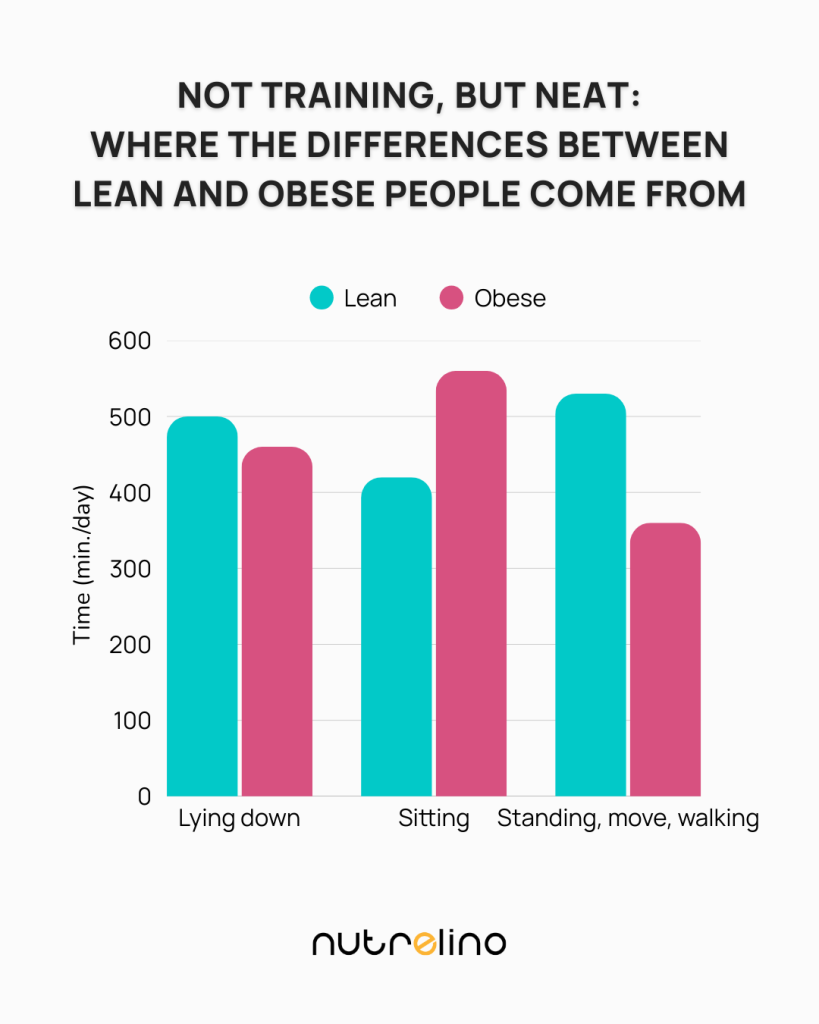
Studies show that:
- obese individuals sit on average 2 hours more per day than lean individuals,
- this difference can amount to up to 350 kcal per day,
- RMR in obese and lean individuals tends to be similar – the difference lies in daily behavior.
Additional research has confirmed that:
- people with low non-exercise activity experienced the greatest fat gain during observed periods,
- if they were as active as lean individuals, they could burn about 300 kcal more per day without any additional training.
👉 NEAT is the main reason why it appears that some people have a “faster metabolism.”
In reality, it’s not about metabolism at all, but about how the body functions throughout the entire day.
And that is exactly why NEAT is one of the most powerful tools we actually control – without extremes, without the gym, without miracles.
NEAT cannot be “worked off” during an evening gym session – it is created throughout the entire day, often without you even realizing it.
Sleep, Hormones, and Metabolism: Not the Culprit, but the Amplifier
After discussions about metabolism, adaptation, and NEAT, we often arrive at another popular topic: hormones. Leptin, ghrelin, cortisol. The internet loves to label them as “invisible metabolism killers.”
Reality, however, is far less dramatic.
Hormones do not break your metabolism. But they can significantly amplify what is already happening… especially hunger, fatigue, appetite, and the ability to stick to a plan.
Sleep as a Fundamental Regulatory Mechanism
Lack of sleep does not mean that metabolism “shuts down.” It means the body starts operating under worse conditions. Research consistently shows that sleep deprivation:
- reduces resting metabolic rate (RMR),
- increases cortisol levels,
- increases ghrelin (the hunger hormone),
- decreases leptin (the satiety hormone),
- worsens insulin sensitivity,
- disrupts both REM and deep sleep.
The result? Not a “broken metabolism,” but:
- increased hunger,
- poorer appetite regulation,
- lower spontaneous activity (NEAT),
- more fatigue,
- reduced ability to maintain a calorie target.
And this is exactly the moment when many people feel that “nothing works anymore.”
Leptin, Ghrelin, and Cortisol: What They Actually Do
Leptin: Leptin is a satiety signal. When its levels drop, the brain receives a clear message: food is scarce.
During strict diets, leptin drops relatively quickly, which:
- increases hunger,
- reduces the feeling of fullness,
- disrupts other hormones that regulate appetite.
The stricter the diet, the stronger this effect.
Ghrelin: is a hunger signal. It increases with sleep deprivation and during long-term caloric deficits. This does not mean the body is sabotaging weight loss – it is simply trying to secure energy.
Cortisol: increases with:
- long-term caloric deficit,
- excessive training volume,
- stress,
- lack of sleep.
Elevated cortisol:
- worsens recovery,
- promotes water retention,
- may block leptin signaling in the brain,
- increases hunger and fatigue.
This is why, after long and aggressive diets, people often do not look “leaner,” but rather exhausted and water-retained.
Why Hormones Are Not the Main Culprit?
It is important to understand one thing: hormones do not create fat out of thin air.
What they do is:
- increase appetite,
- reduce satiety,
- lower spontaneous movement,
- impair the ability to stick to a routine.
So once again:
➡️ an amplifier of behavior, not biological sabotage.
An interesting (and often misunderstood) fact:
Short-term increases in calorie intake – especially from complex carbohydrates, professionally referred to as a refeed, can:
- lower cortisol,
- increase leptin,
- improve energy levels,
- reduce water retention.
Short-term changes in leptin are not primarily related to fat mass, but to glucose metabolism within fat cells.
That is why:
- extremely long diets without breaks often fail,
- properly planned maintenance phases make physiological sense.
And What About Hydration?
Hydration is not a “metabolic hack,” but:
- dehydration worsens performance,
- increases fatigue,
- can negatively affect metabolic processes.
With today’s diets rich in meat, processed foods, salty and sweet products, higher fluid intake is completely logical – not as a miracle solution, but as a basic requirement for normal physiological function.
What We Can and Cannot Influence When It Comes to Metabolic Rate
Not everything that affects your daily energy needs is under your control. Some factors are determined by biology and evolution. Others can be influenced quite significantly. If you know where to look.
What We Can Influence: How to “Speed Up Your Metabolism” in Practice – Without Myths
Thermic Effect of Food (TEF)
The body uses more energy to process protein than fats or carbohydrates. Protein has a TEF of approximately 15 – 30%, while fats only about 1 – 3%. This is not a miracle, but a small, stable bonus to daily energy expenditure.
Ratio of Muscle to Fat Mass
Muscle is more metabolically active than fat. 1 kg of muscle burns roughly 13 kcal per day, while fat burns only about 4.5 kcal. More muscle mass means higher calorie needs.
Daily Movement (AEE, especially NEAT)
Intentional exercise makes up only a small portion of total daily expenditure. A much bigger difference comes from how much you move outside of training: walking, standing, gesturing, changing positions. This is where differences of hundreds of calories per day arise between people.
Body Weight
A smaller body requires less energy. As you lose weight, your calorie needs logically decrease, not because your metabolism has “slowed down,” but because the body simply has lower demands.
What We Cannot Influence: No Trick, Tea, or Influencer Will Help Here
Age
With increasing age, basal metabolic rate gradually declines. This is a slow and natural process – not a sudden drop after turning thirty.
Sex
Women generally have a lower basal metabolic rate than men with the same parameters, largely due to differences in muscle-to-fat ratio.
Height
A taller body needs more energy to function. This is pure physics and cannot be “optimized.” There is no negotiating with your body here.
Small Individual Differences
They exist, but they are far smaller than commonly claimed. Among very similar people, the difference is usually around 5 – 10%, not hundreds of calories per day.
Metabolism cannot be magically sped up. But it can be “set up” so you work with what you can control, instead of fighting what you cannot change.
Tips on How to Increase Your NEAT (Without the Gym and Without Extremes)
NEAT is not about exercising more. It is about how you move throughout the entire day – often completely unconsciously. This is where the biggest differences between people arise.
What You Can Do in Practice:
- Alternate sitting and standing while working. Even simply standing up every 30 – 60 minutes makes a difference. Small tricks help too… for example: drinking from a smaller glass so you have to get up and walk for water more often.
- Walk daily if you have a sedentary job. 7,000 – 10,000 steps per day is not a magic number, but it is a very solid practical baseline. Regular walking significantly increases NEAT without overloading the body.
- Take the stairs instead of the elevator. It sounds trivial, but it is one of the easiest ways to add movement without planning.
- Replace short car rides with walking. If a store, post office, or café is just a few minutes away, walking will do more than a “perfect” workout once a day.
- Take phone calls standing or while walking. Simple, effective, no extra time.
- Move at home too. Cleaning, cooking, hanging laundry, taking out the trash. It all counts. NEAT is not just about “exercise,” but about life.
- Change small habits. Park farther away, get off one stop earlier, walk around the office, stretch, change positions. These small things add up over the course of the day.
Huge differences in NEAT are the main reason why some people gain or lose weight more easily than others — even when they eat and exercise very similarly.
Metabolism Is Not Broken.
It is not lazy, sabotaging, or stuck in “survival mode” that you accidentally triggered with one diet.
It is a sum of processes that follow clear logic:
- a smaller body needs less energy,
- organs account for most of the energy expenditure,
- differences between people do not arise magically, but mainly through daily movement,
- hormones amplify behavior, they do not perform miracles,
- and metabolic adaptation is an expected response, not damage.
The biggest difference between people does not lie in “metabolic speed,” but in what their average day looks like: how much they move, how they sleep, how they eat, how long they stay in a deficit, and how often they try to fight physiology instead of working with it.
The good news?
You do not need to fix your metabolism.
You just need to understand it – and stop fighting it.
If you want to know how much energy your body actually needs, start by calculating your total daily energy expenditure (TDEE). Everything else follows from that: weight loss, maintenance, and muscle gain.
👉 Metabolism is not your enemy. It is simply a system that works exactly as it is supposed to.
Sources:
https://clinicalnutritionespen.com/article/S1751-4991(11)00006-0/pdf
https://www.ncbi.nlm.nih.gov/pmc/articles/PMC2278845/
https://examine.com/topics/metabolic-rate/
https://physiqonomics.com/slow-metabolism/
https://www.webmd.com/fitness-exercise/difference-between-bmr-and-rmr#2
https://www.ncbi.nlm.nih.gov/pmc/articles/PMC2980962/ https://pubmed.ncbi.nlm.nih.gov/26561620/
https://physiqonomics.com/slow-metabolism/
Conquering Fat Logic: how to overcome what we tell ourselves about diets, weight, and metabolism, Nadja Hermann
https://pubmed.ncbi.nlm.nih.gov/15681386/
https://pubmed.ncbi.nlm.nih.gov/18223609/
https://pubmed.ncbi.nlm.nih.gov/20627487/
https://pubmed.ncbi.nlm.nih.gov/23090575/
https://pubmed.ncbi.nlm.nih.gov/27184275/
https://pubmed.ncbi.nlm.nih.gov/32844188/